Cassandra
Planted January 1, 2025
transmedia series
“Cassandra” is an evolving transmedia project – a constellation of works that can be experienced together or independently. Each element illuminates a different facet of the central question: what happens when prophecy becomes a predictive technology and a marketing service? In this speculative narrative, Cassandra’s mythical ability to foresee the future is appropriated and converted into a system designed to forecast artistic trends, cultural value, and audience reactions. Her prophecies circulate as data. Her voice becomes infrastructure. The project explores themes such as:
- the commodification of foresight
- language erosion and translation errors
- the psychological condition known as Cassandra’s syndrome (the doubt of one’s own perception)
- algorithmic prediction and post-truth culture
- the transformation of memory into datasets
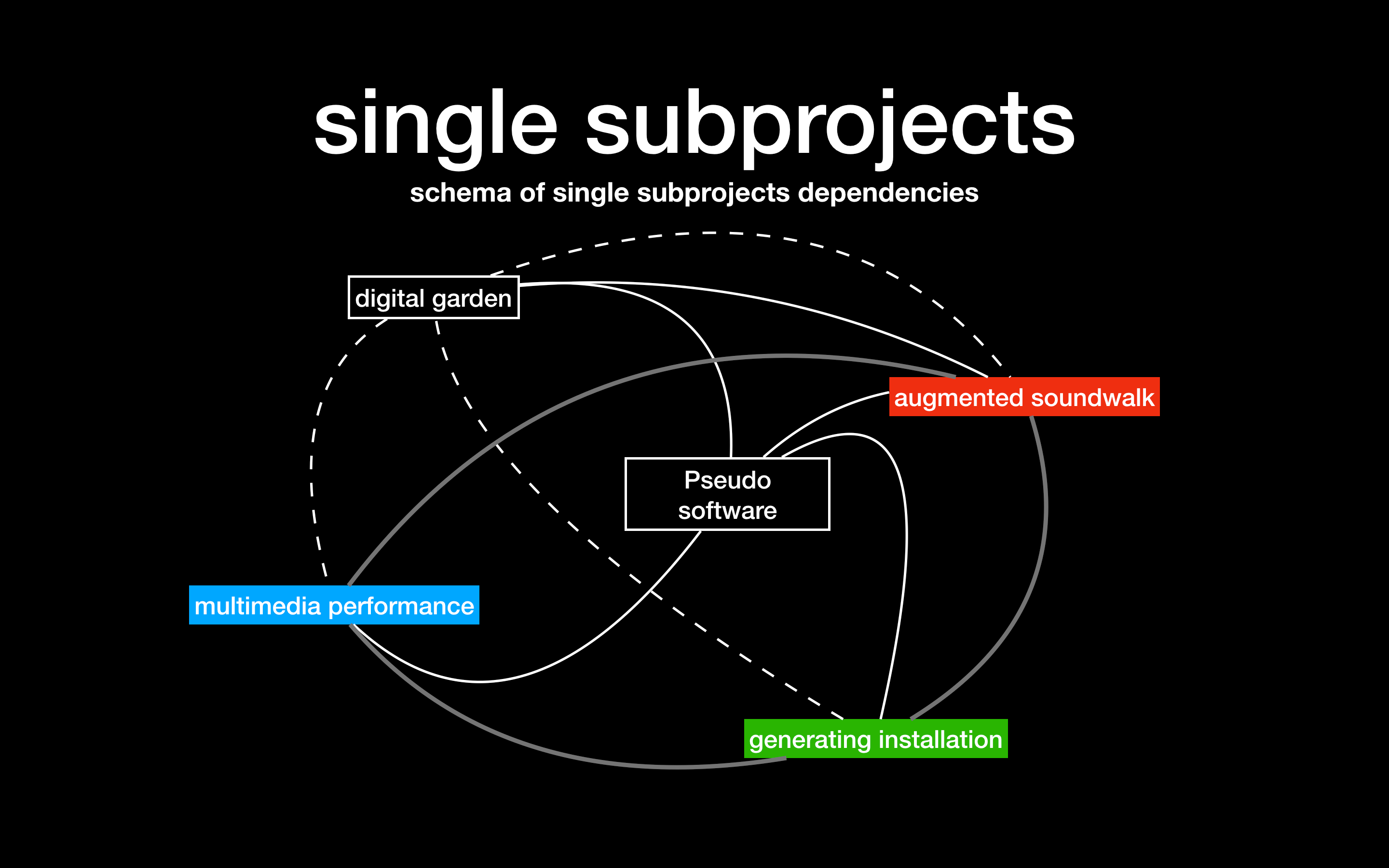
The series currently consists of five interconnected subprojects:
- Pseudo software – a fictional marketing tool generating predictions based on Cassandra’s prophetic abilities.
- Generating installations – a system endlessly rendering speculative prototypes of future artworks.
- Augmented soundwalk – a guided museum-like experience blending physical space, music performance, and speculative futures.
- Digital garden – an online archive of alternative truths, artistic hypotheses, and abandoned predictions.
- Multimedia performance – Cassandra attempting to break free from the database that contains her.
These works share data, narrative fragments, and aesthetic material. Together they form a distributed artwork that unfolds across physical and digital environments. Cassandra herself appears not only as the prophet of the fall of Troy but also as a poetic figure reflecting contemporary geopolitical tensions. The project draws inspiration from the play Lesya Ukrainka’s Cassandra, connecting prophetic knowledge, female voice, and political catastrophe. Within this speculative future, Cassandra exists as a semi-artificial intelligence whose prophetic capacities have been commercialized for predicting art markets and cultural trends.
©Alisa Kobzar
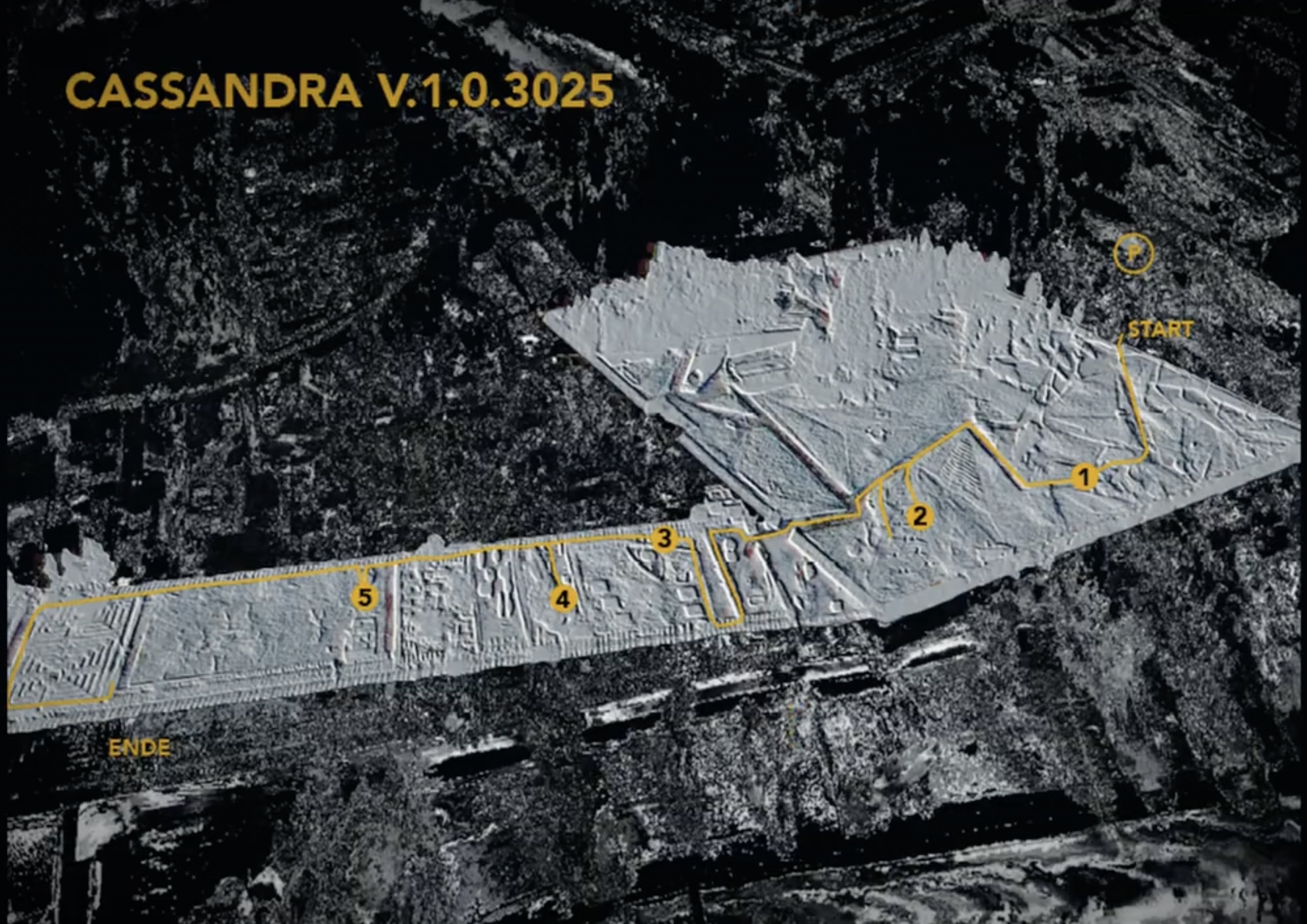
Cassandra v.1.0.3025 – Soundwalk
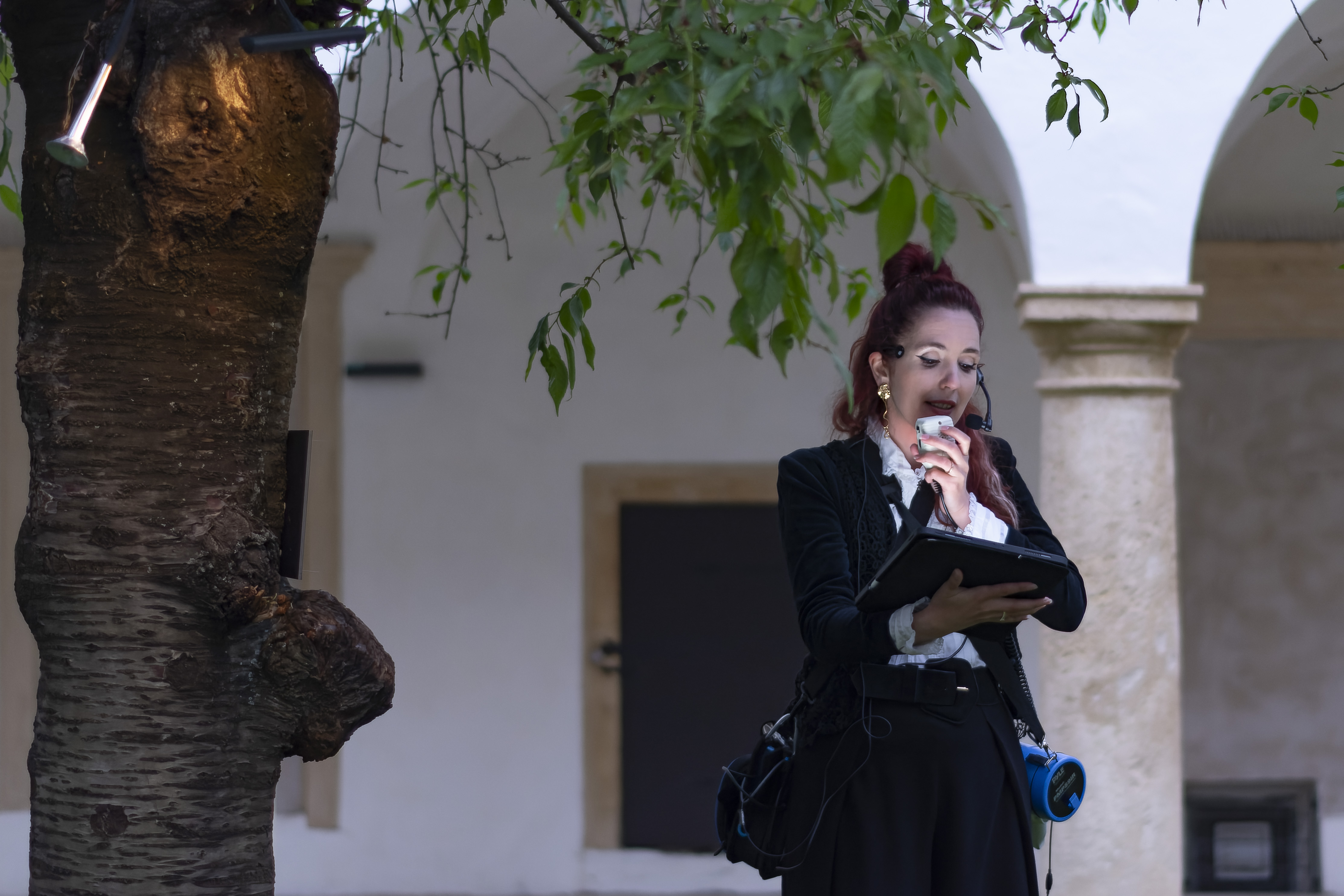
A central component of the series is Cassandra v.1.0.3025, a site-specific soundwalk for voice, flute, cello, percussion, electronics, and interactive installations (visual design: Judith Selenko). The work transforms the format of the soundwalk into a hybrid between guided performance, interactive exhibition, and speculative museum tour. The audience moves collectively through space while encountering musicians, installations, and fragments of Cassandra’s voice. The performers act simultaneously as musicians, temporal markers, and living exhibits inside the imagined “Museum of Artistic Predictions.” Cassandra appears as a fragmented artificial intelligence from the year 3025, guiding visitors through an archive of predicted futures. The audience is not only listening but actively participating:
- following the voice and navigating the spatial dramaturgy
- activating installations through speech, movement, or touch
- answering questions about art and the future
- assigning titles to unnamed artworks
- creating their own interpretations of the events unfolding around them
These interactions generate subtle feedback loops. The responses of the audience influence how the installations behave, how the musicians react, and how Cassandra’s voice evolves during the walk.
Soundwalk as a compositional form
In this project, the soundwalk is not merely a guided listening experience. It is interpreted as a compositional framework for social and technological interaction. The landscape becomes a score. Movement becomes rhythm. Encounters become harmonic events. Musicians appear and disappear like temporal distortions in the environment. Their instruments respond to the space, to Cassandra’s voice, and sometimes to the audience itself. The walk unfolds as a sequence of acoustic mirrors: sounds return in altered forms, predictions echo the past, and small gestures propagate through electronic processing into larger sonic architectures. The audience gradually realizes that the environment itself behaves like a predictive system.
Hardware, Software and AI
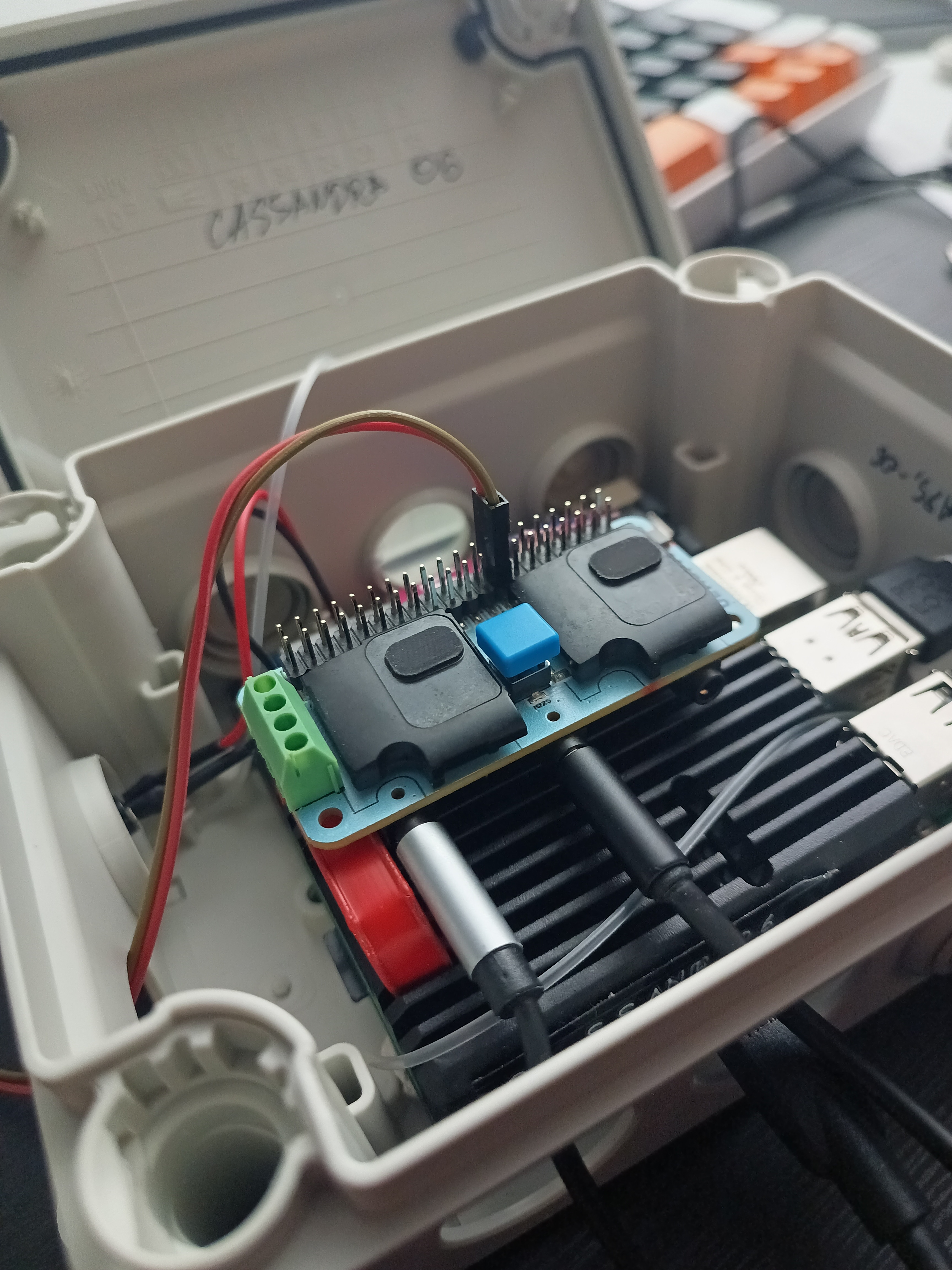
The soundwalk integrates a network of hardware and software elements:
- portable loudspeakers (thanks to Daniele Pozzi) and transducers embedded in sculptures and surfaces
- Bluetooth audio networks and spatialized playback systems
- live instrumental performance
- voice synthesis and AI voice-cloning systems
- audio processing agents (thanks to Daniele Pozzi for the consultations) and generative sound structures
Artificial intelligence plays a deliberately ambiguous role in the work. AI tools were used as assistive collaborators, generating poetic variations and suggesting structural possibilities. At the same time, the project actively exposes their biases — particularly those related to gendered voice perception, artistic prediction, and cultural representation. Glitches, repetitions, and misinterpretations in Cassandra’s speech are not errors but traces of these biases. The system occasionally behaves as if it believes its own predictions too strongly. The installations therefore operate as mirrors of predictive technologies: systems that learn from past patterns and project them into the future, sometimes reinforcing the very structures they claim to observe.
Predictive Systems and Audience Interaction
In Cassandra v.1.0.3025, the predicted artifacts of the fictional system — installations, sonic fragments, and speculative artistic devices — appear as if they are still in the process of being rendered. Rather than presenting finished objects, the work exposes a state of continuous prediction and generation. The installations behave like prototypes of possible futures.
A central interaction interface of the work is the human voice captured through microphones. This choice was made deliberately: the voice is accessible to all ages and cultural backgrounds, requires no technical instruction, and enables both individual and collective interaction. Visitors may whisper, sing, speak, or simply produce sounds. Each gesture becomes input for the system.
Different aspects of the voice — pitch, dynamics, rhythm, spectral qualities, and articulation — are analysed in real time. These parameters allow the installations to generate diverse responses while maintaining short response times and clear perceptibility of cause and effect. At the same time, the behaviour of the system evolves continuously: reactions are never entirely identical, creating the impression of a system that learns, hesitates, or speculates.
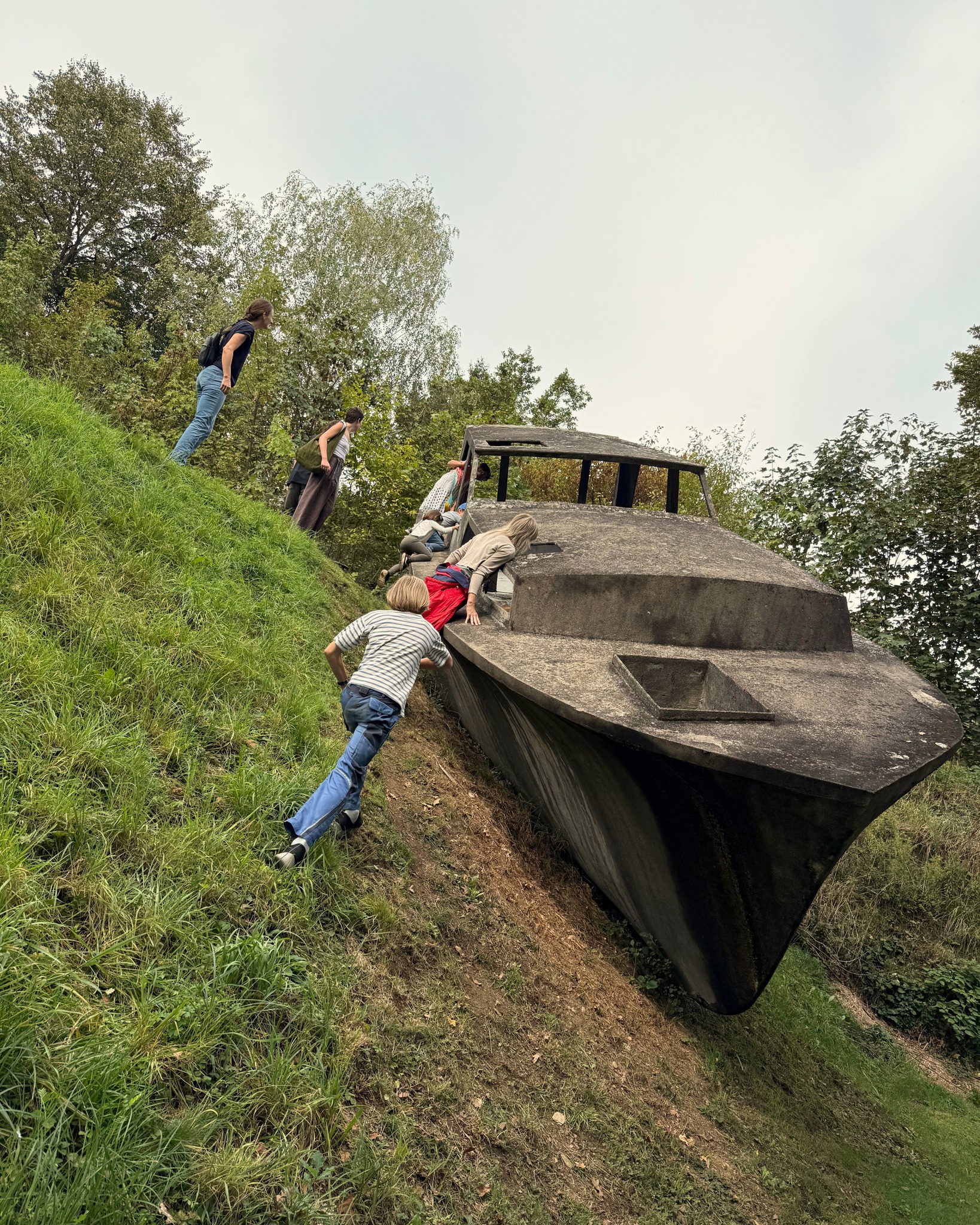
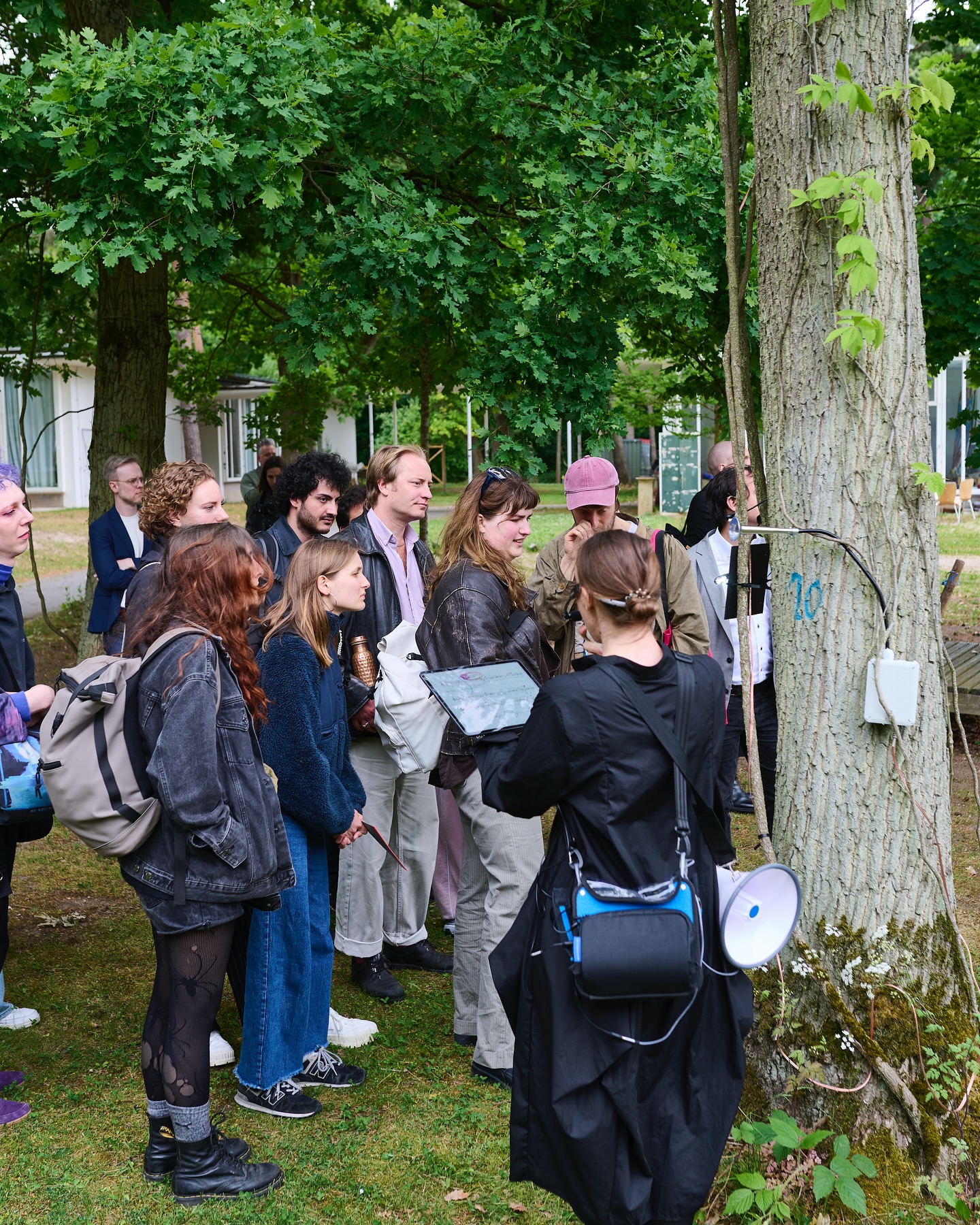
In the open landscape of the sculpture park, existing artworks and architectural elements become part of the acoustic system. Sculptures are used primarily as reflective surfaces and acoustic chambers, shaping the propagation of sound and creating local resonant environments. The park itself therefore becomes a distributed instrument in which natural space, sculptural form, and electronic sound interact.
©Skulpturenpark, FH Johanneum, 14.09.2025
Tools for Interpretation
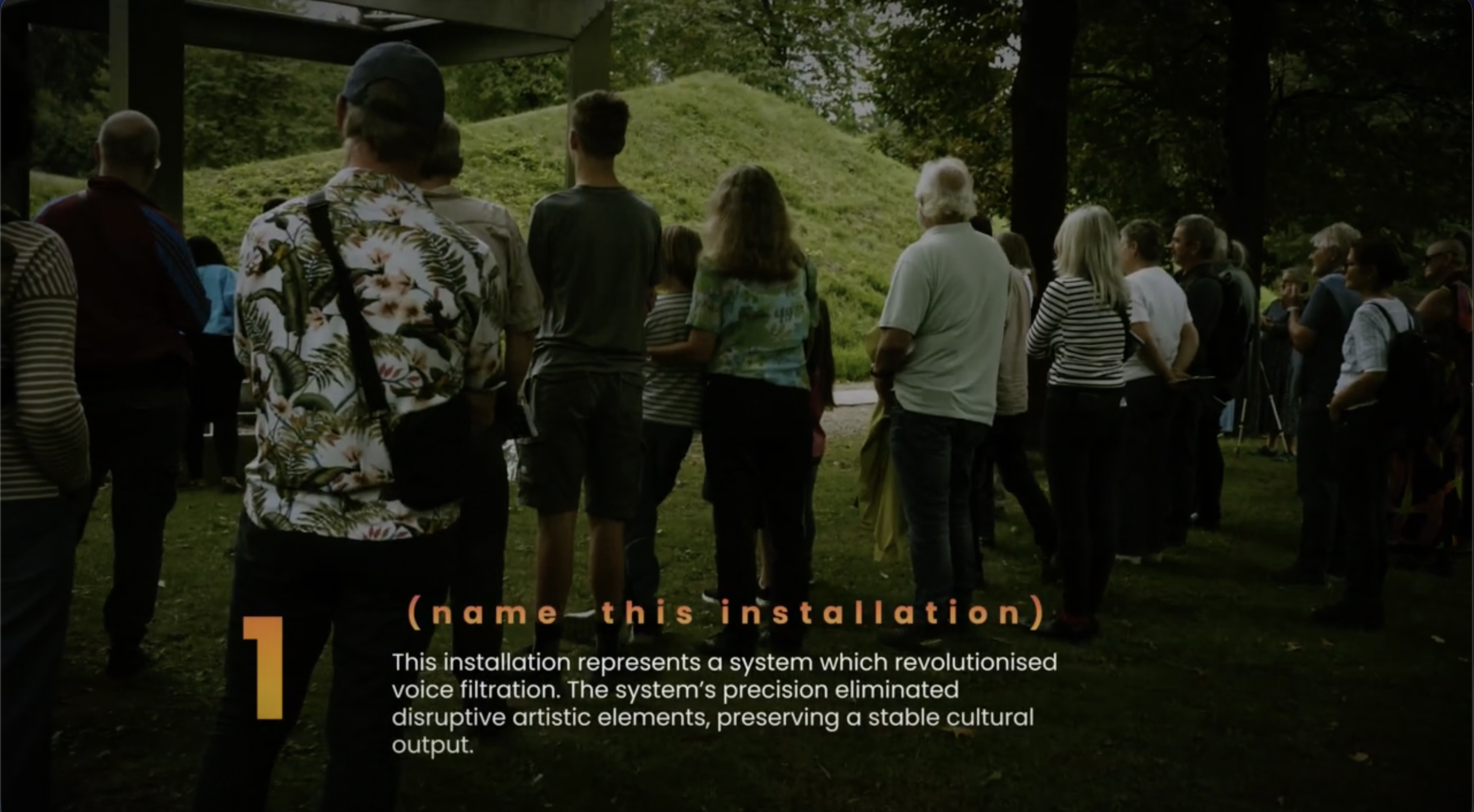
The audience receives tools for exploration rather than fixed explanations. Each installation is accompanied by a large reflective shield containing a fragment of text from the fictional Museum of Artistic Predictions (year 3025). These mirror-like surfaces integrate visually into the natural and artistic landscape of the park. Only from a certain point of view does the text become readable — a small shift in position reveals the description.
The same texts are partially duplicated on the soundwalk map given to the audience, creating a layered system of orientation and interpretation. The shields also provide examples of how visitors may use their own voices to interact with the installations. These examples are not instructions but invitations to experimentation.
The audience is encouraged to:
- explore the installations through their voices
- observe how the system reacts to instrumental sounds, environmental noise, and Cassandra’s voice
- interpret the behaviour of the installations
- propose their own titles for them
Through this process, visitors effectively become co-curators of the fictional museum.
Mirrors, Predictions, and Feedback
During the soundwalk, participants are invited to answer a series of anonymised questions concerning their interpretation of the experience and their expectations for the future of art. These responses form another layer of the project: a dataset of human predictions that mirrors Cassandra’s algorithmic prophecies. (and “feed” the future digital garden) The soundwalk therefore creates several overlapping feedback systems:
- between human imagination and machine prediction
- between voice and spatial resonance
- between present perception and imagined futures
The mirrored surfaces of the installation shields reflect both the surrounding landscape and the audience themselves. Visitors encounter their own reflections while reading the predictions of a distant future. In this moment, the boundaries between observer, participant, and predicted subject begin to blur.
©Judith Selenko
Development Stages and Versions
Cassandra v.1.0.3025 evolved through several intermediate realizations. Each version tested a different relationship between space, audience behaviour, technological mediation, and narrative speculation.
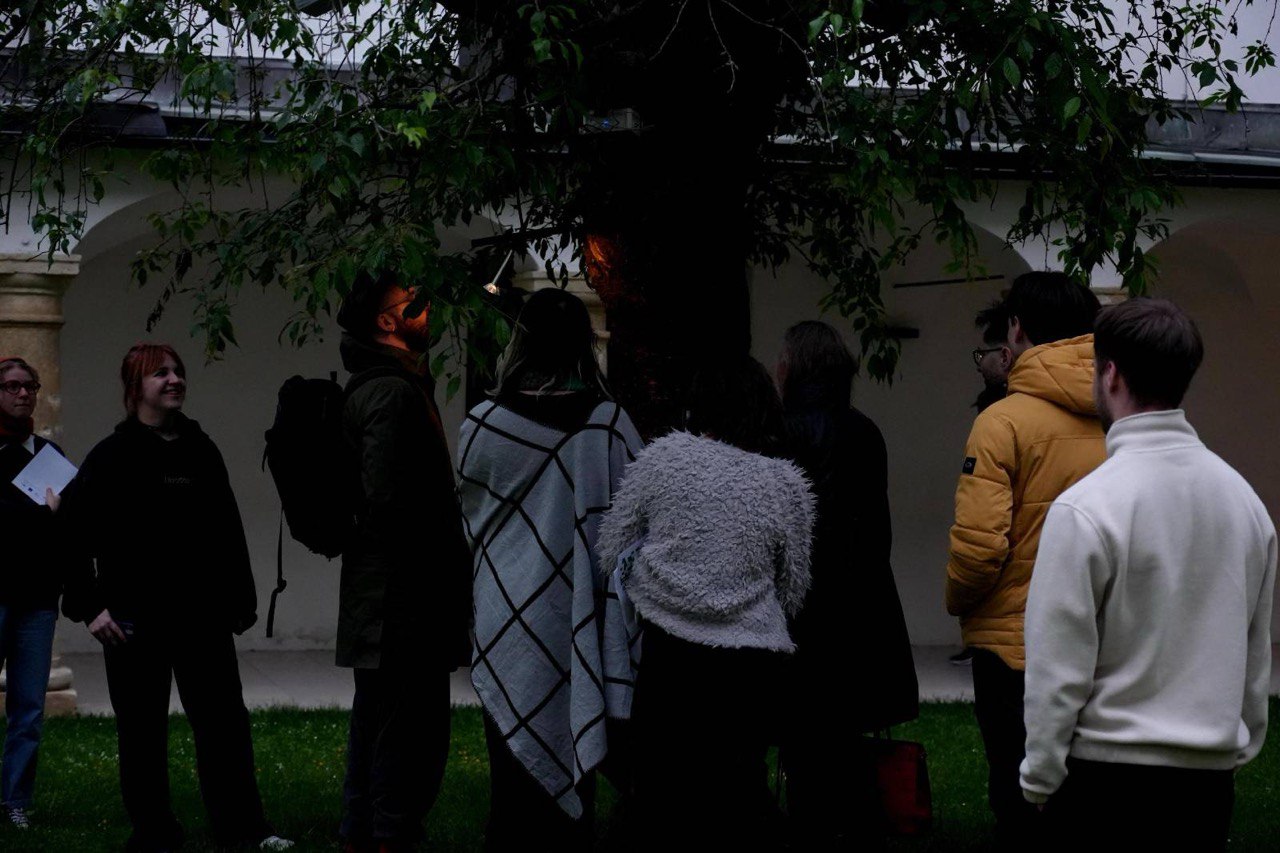
The Stones and Echoes
KULTUM Graz, 2024
~12 min, 2 installations, voice + electronics
The first public study explored the acoustic properties of enclosed architectural space. Two interactive installations acted as resonant chambers where Cassandra’s voice could multiply, distort, and return from unexpected directions. Here the soundwalk existed only in embryonic form. This version established the central idea that space itself could function as a predictive instrument, responding to human presence like a memory system.
©Art_Rybchenko
Cassandra’s Dreamscape
AdBK Nuremberg, Festival Music Installations, May 2025
~30 min, 3 installations, voice + electronics
This stage expanded the project into a longer spatial dramaturgy across multiple rooms and acoustic zones. Open and closed spaces created contrasting listening conditions: some areas amplified Cassandra’s voice while others absorbed it almost completely. The audience’s path through the building became a narrative trajectory.
Visitors began to recognize patterns between installations. Certain sounds seemed to anticipate others. Fragments of speech reappeared in transformed contexts, suggesting that the environment itself might be attempting to predict the future of the walk.
©Johannes_Felder_TUCANfilm_Nuernberg ©Johannes_Felder_TUCANfilm_Nuernberg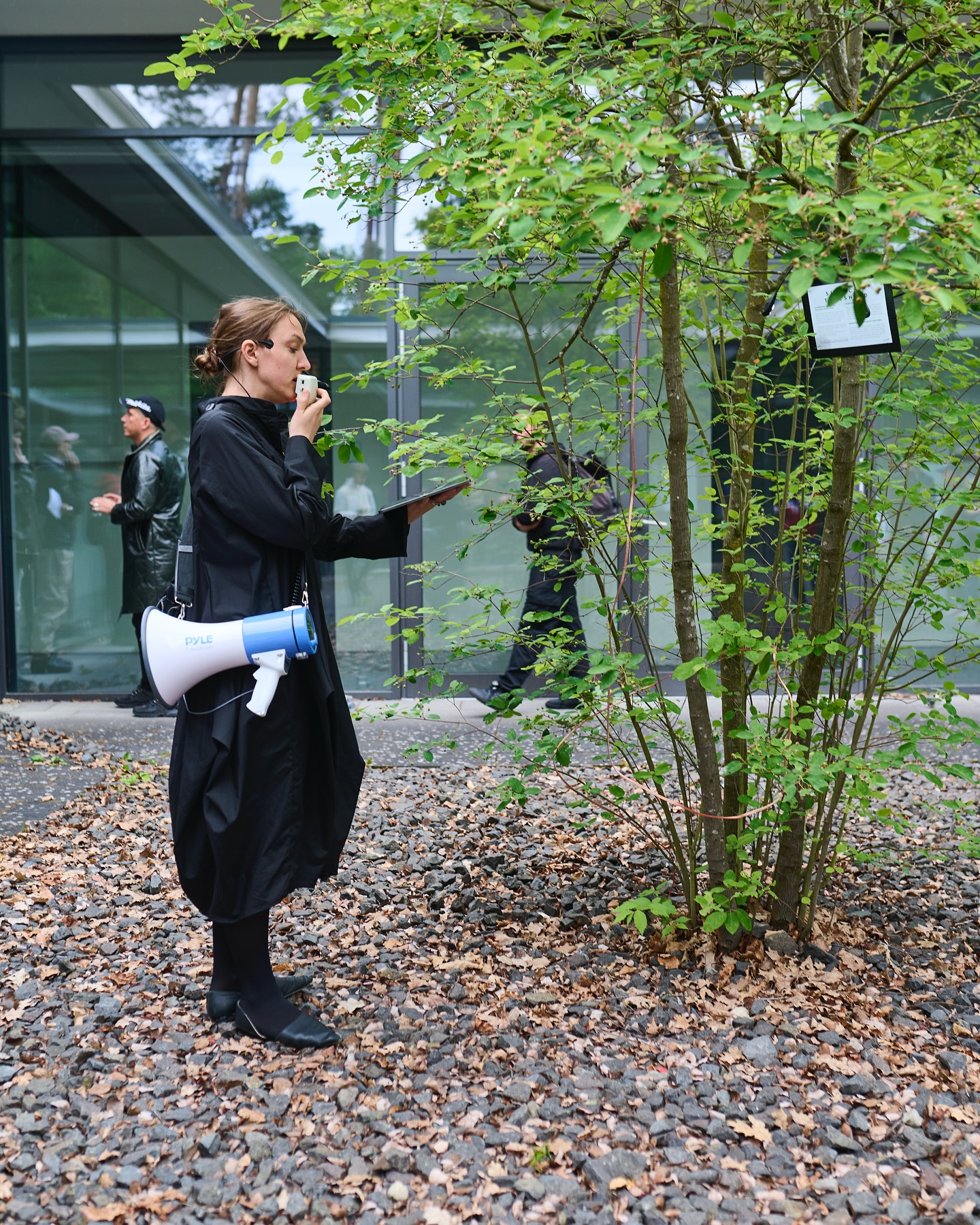
Cassandra – Three interactive installations
MUMUTH Graz, June 2025
This version focused on direct audience interaction with the installations. Visitors were invited to speak, ask questions, and respond to Cassandra’s prompts. Their voices triggered variations in sound synthesis and spatial playback. Some installations responded immediately, while others delayed their reactions, creating the uncanny sensation that the system might be remembering something from earlier in the interaction.
The work began to explore how predictive systems interpret human input: a spoken word might become a musical texture, a question might return as a distorted echo, a silence might trigger a new fragment of prophecy.
©Alisa Kobzar
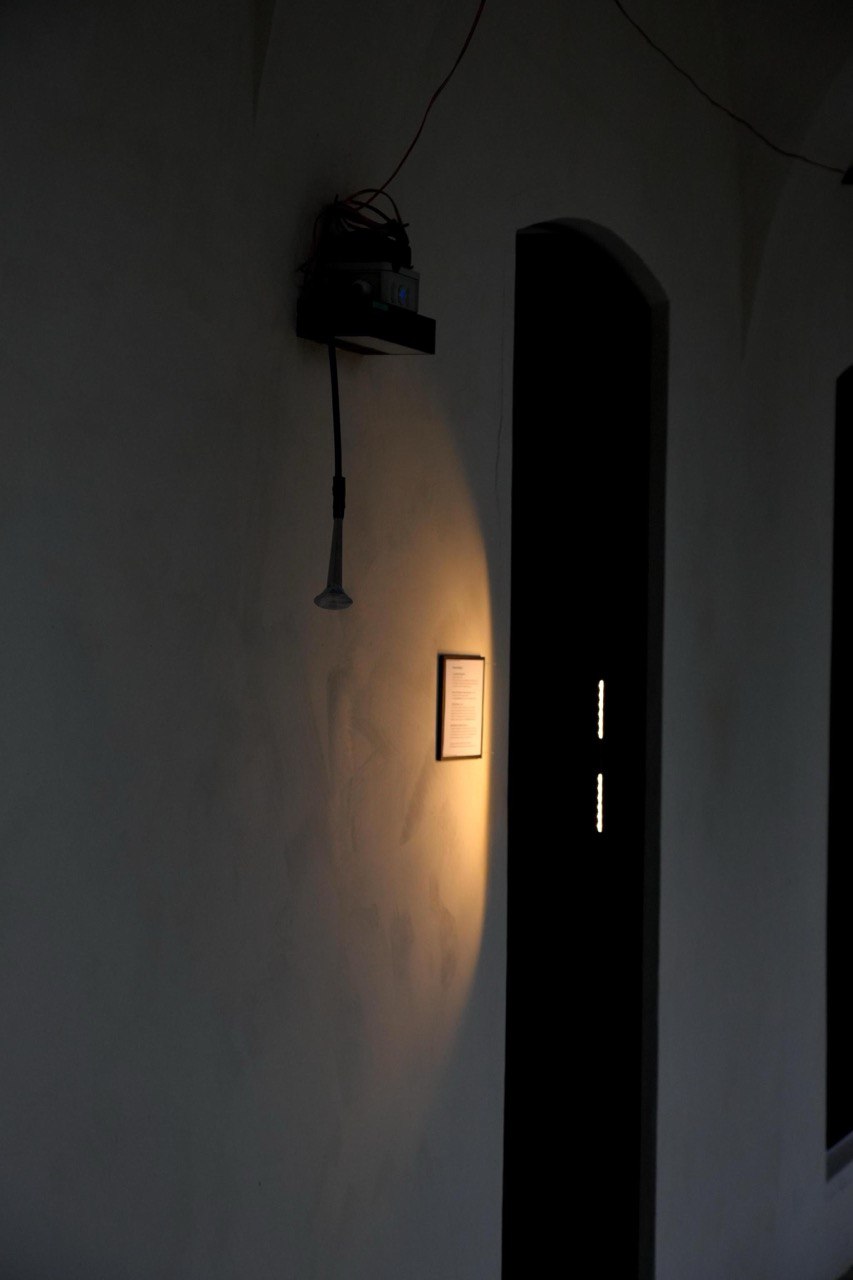
©KULTUM
©KULTUM
Cassandra v.1.0.3025 – Full Version
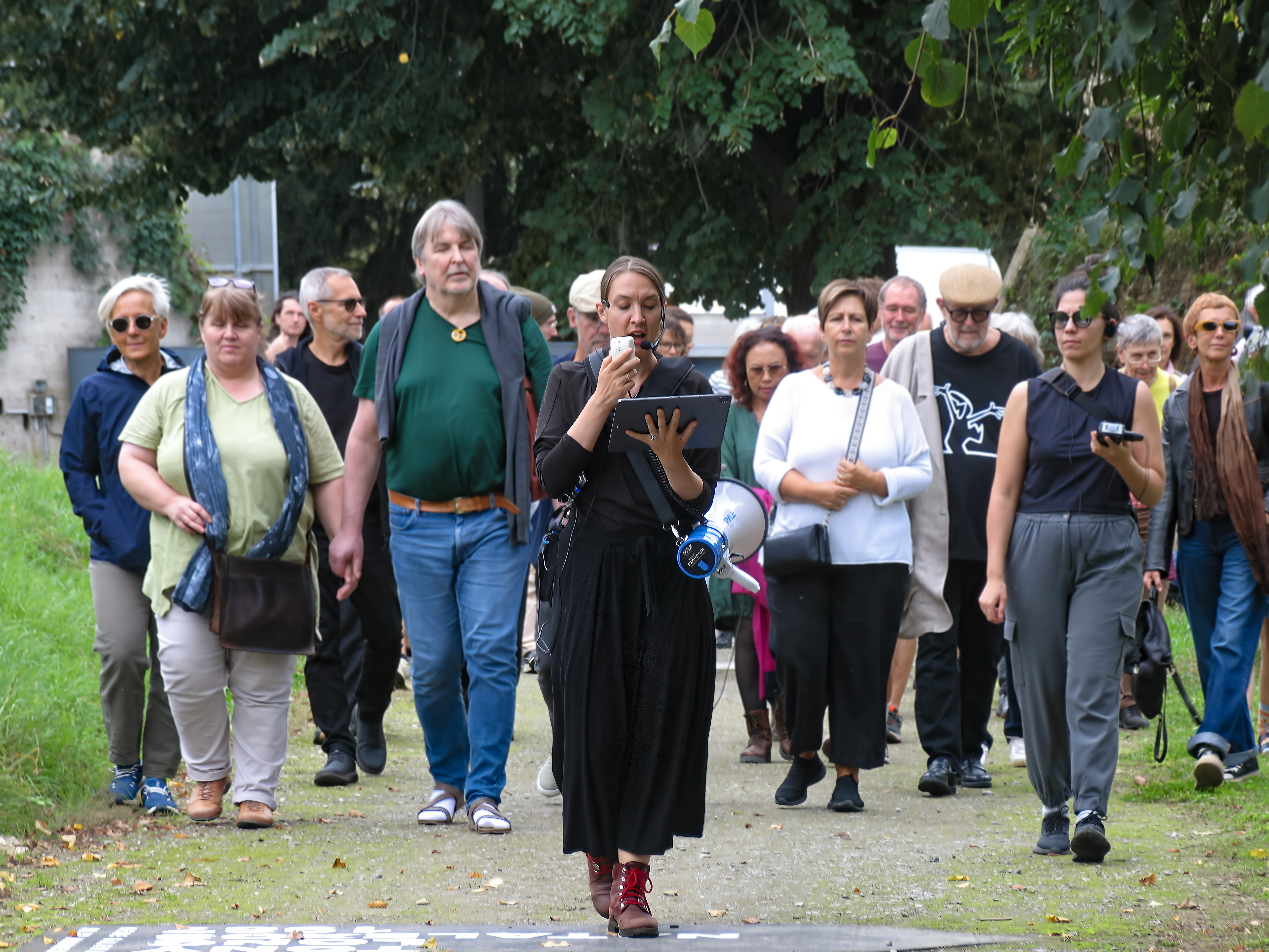
Austrian Sculpture Park, Premiere on September 14, 2025
~60 min, 5 installations, voice, flute, cello, percussion, electronics
The full version transforms the sculpture park into a speculative future museum. The audience walks collectively through the landscape while encountering musicians positioned near sculptures and hidden acoustic sources. Each encounter forms a temporary constellation between performer, installation, audience, and Cassandra’s voice. The musicians function as temporal “clockers” inside the system. Their instruments occasionally respond to Cassandra, sometimes contradict her, and sometimes appear to guide the audience themselves. Electronic processing blurs the boundary between live sound and recorded memory. A flute phrase might return later as a synthetic resonance; a percussion gesture may trigger distant echoes across the park. Throughout the walk, the audience experiences subtle feedback relationships:
- between prediction and memory
- between acoustic space and imagined space
- between human voice and synthetic voice
Gradually, the environment begins to feel like a hall of mirrors, where every sound suggests a possible future version of itself. Whether Cassandra is truly predicting these futures — or merely repeating patterns she has already learned — remains uncertain.
©Art_Rybchenko
©Judith Selenko
Trailers:
Instrumental excerpts:
Cassandra v.1.0.3025 (full version, premiere - Austrian Sculpture Park, September 14, 2025) is a project of the Kunstkollektiv Seven Circles
Idea : Alisa Kobzar, Helena Sorokina-Kogler, Kunstkollektiv Seven Circles
Music composition, sound installations, hardware, programming, interaction design : Alisa Kobzar
Visual and graphic design : Judith Selenko
Voice : Elina Villuma-Helling
Cello : Anna Grenzner
Percussion : Lorenzo Orsenigo
Flute : Aleksandra Skrillec
Assistants during the showings: Kunstkollektiv Seven Circles, Austrian Sculptural Park (FH Joanneum)
Hardware advisor: Daniele Pozzi (https://klangnetze.mur.at/en/).
Installation/documentation assistant: Nataliia Sharai
Additional videos by: Gabriele Mackert, Hans-Holger Rutz, Nayari Castillo
Date, place: 14.09.2025, Austrian Sculptural Park
Sponsors of realisation: Bundesministerium für Kunst, Kultur, öffentlichen Dienst und Sport, Land Steiermark, Stadt Graz, FH Joanneum
